Republican Populist by unknow
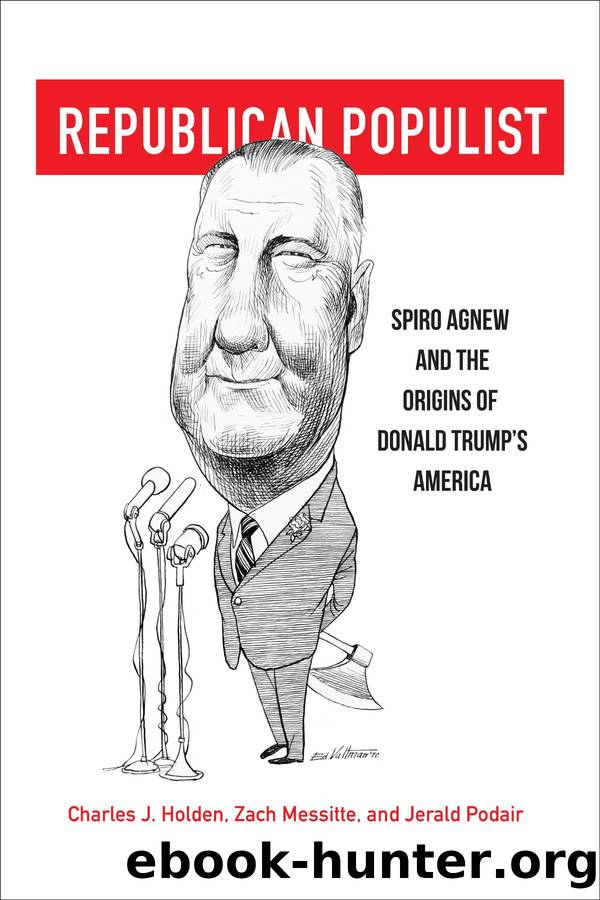
Author:unknow
Language: eng
Format: epub
Tags: HIS036060 History / United States / 20th Century
Publisher: Lightning Source Inc. (Tier 3)
5
DIXIEâS FAVORITE
Agnew and the Southern Strategy
In April 1972, as the presidential election season was kicking into gear, Congressman William Dickinson, a Republican from Alabama, invited Spiro Agnew to attend the upcoming Independence Day celebration in Montgomery. Dickinsonâs election to Congress in 1964, when he defeated a long-standing Democratic incumbent, was part of the growing success of the Republican Party in encouraging conservative white southerners to abandon the party of their ancestors.1 Dickinson made headlines his first year in office when he accused the organizers of the famous march from Selma to Montgomery of engaging in biracial sex parties. âDrunkenness and sex orgies were the order of the day,â he proclaimed. A collection of âhuman flotsamâadventurers, beatniks, prostitutes, and similar rabble . . . engaged in an all-night session of debauchery within the church itself,â Dickinson charged, adding, âOnly by the ultimate sex act with one of another color can they demonstrate they have no prejudice.â2 Now in 1972, as part of the effort to transform the white south into the Republican Partyâs conservative base, Dickinson knew that Agnew could help the cause. Therefore it was not just the usual political flattery when Dickinson wrote, âMr. Vice President, Alabamians love Spiro Agnew.â3
By 1969 the national press had already recognized Agnewâs strength in growing the GOP in the southern states. In December the New York Times reported that an Arkansas Democrat had conceded, âIt used to be that at a Democratic meeting of any kind, you were safe to lead off with a Spiro Agnew joke. But no longer.â The vice president, the article continued, âis one of the most popular men in the Southâ and âthe new leader in the drive to expand Republican strength in the South.â4 By 1971 Agnew was being hailed as âDixieâs favorite.â5 Harry Dent, Strom Thurmondâs right-hand man, recalled that âAgnew became not only a beloved household name in the South, but even to many he became âSpiro, Is My Hero.ââ6 By the end of his first term some southern conservatives even voiced a preference for Agnew over Richard Nixon. Political analysts Richard Scammon and Ben Wattenberg relayed the sentiments of one southern politician who said âhe was voting for Agnew in 1972, and if that means voting for Nixon, so be it.â7
That Agnew would emerge as a key figure in the transformation of the white South into a Republican bastion would have come as a great surprise to the political pundits of just a few years earlier. Agnew, after all, came out forcefully against George Wallace when the Alabama governor campaigned in Maryland during the 1964 Democratic primary. Kevin Phillips didnât mention Agnew in his sweeping analysis of the 1968 election, The Emerging Republican Majority, which includes an examination of the partyâs success in the South. Agnewâs nomination as Nixonâs vice presidential candidate was largely seen as a compromise to placate competing regional and ideological factions, although it is significant that the leading southern Republican of the day, South Carolinaâs Thurmond, played a key role in the final selection.
Download
This site does not store any files on its server. We only index and link to content provided by other sites. Please contact the content providers to delete copyright contents if any and email us, we'll remove relevant links or contents immediately.
| Elections & Political Process | Ideologies & Doctrines |
| International & World Politics | Political Science |
| Public Affairs & Policy | Specific Topics |
| United States |
The Secret History by Donna Tartt(18974)
The Social Justice Warrior Handbook by Lisa De Pasquale(12172)
Thirteen Reasons Why by Jay Asher(8858)
This Is How You Lose Her by Junot Diaz(6845)
Weapons of Math Destruction by Cathy O'Neil(6231)
Zero to One by Peter Thiel(5743)
Beartown by Fredrik Backman(5691)
The Myth of the Strong Leader by Archie Brown(5474)
The Fire Next Time by James Baldwin(5398)
How Democracies Die by Steven Levitsky & Daniel Ziblatt(5185)
Promise Me, Dad by Joe Biden(5120)
Stone's Rules by Roger Stone(5060)
A Higher Loyalty: Truth, Lies, and Leadership by James Comey(4923)
100 Deadly Skills by Clint Emerson(4888)
Rise and Kill First by Ronen Bergman(4747)
Secrecy World by Jake Bernstein(4712)
The David Icke Guide to the Global Conspiracy (and how to end it) by David Icke(4664)
The Farm by Tom Rob Smith(4475)
The Doomsday Machine by Daniel Ellsberg(4463)
